Moving With Age
Moving With Age is a practical ethnography project created in partnership with Woven by Toyota. The study explored how older adults move through New York City’s transit system, especially when stairs, crowds, unclear announcements, and disruptions make a trip harder than expected.
Through interviews, station observations, secondary research, and journey mapping, we found that the problem was not only access. It was confidence. Our final direction combined Compass, a companion transit app for caretakers and older riders, with Social Signals, a public-facing campaign that encourages commuters to make space, offer help, and support older riders in the moment.
Year
2026
Duration
4 Months
Domain
Mobility Research

Challenge
Older adults are often expected to navigate a transit system that was not designed around their physical, emotional, or informational needs. Even when information exists, it is often too fragmented, too noisy, or too hard to act on during a real trip.
Problem Statement
How might we redesign NYC’s public transport and mobility touchpoints so older adults can travel without sacrificing comfort, safety, or independence?
1
A Persona Built From Real Friction
Margaret, a 71-year-old rider, became our synthesized persona for understanding the experience of older non-commuters. Her journey represents recurring patterns from our research: careful planning, inaccessible stations, crowding, unclear updates, and dependence on family when the system becomes uncertain.
Understanding the Problem
The main breakdown was uncertainty, but it was also shaped by uneven access. Our secondary research showed that many ADA-compliant subway stations are concentrated in Manhattan, while many older adults live outside those transit hubs. This meant that the system was not just hard to navigate in the moment - it was uneven before the trip even began Older riders were not only asking, “Can I get there?” They were asking, “Can I get there without stairs, confusion, crowding, or needing someone to rescue the trip if something changes?”
Approach
Field Research
Interviewed older adults about transit routines, disruptions, and confidence.
Observed riders at subway stations across two boroughs.
Studied how people respond when service information becomes unclear.
Looked closely at moments where riders had to rely on others.
Secondary Research
Reviewed MTA reports, accessibility patterns, and online forums.
Compared where older riders live with where ADA-compliant stations are located.
Studied workarounds like printed maps, handwritten routes, and family group chats.
Used the research to understand what the system leaves unsupported.
Journey Mapping
Created Margaret’s journey map from planning to arrival.
Tracked emotional shifts across each stage of the commute.
Identified where confidence dropped before and during the trip.
Used the journey to turn research findings into design opportunities.
Research Questions
How does uncertainty shape the decision to travel?
For older riders, uncertainty starts before the trip. A route may look simple on a map, but stairs, crowds, elevator status, transfers, and disruptions can change whether the trip feels possible.
What support systems do older riders rely on?
Support is often informal. Riders depend on family members, neighbors, printed notes, saved routes, or phone calls when the system becomes difficult to understand.
Where does confidence break down?
Confidence breaks down when information is available but not actionable. A loud announcement, a crowded platform, or a route change can leave riders unsure of the next step.
Key Insights
Access Is Uneven
Most ADA-compliant stations are concentrated in Manhattan, while many older riders live outside those transit hubs.
Uncertainty Starts Early
Older riders often begin planning around possible failure before they even leave home.
More Information Is Not More Confidence
Transit systems often provide updates, but riders still need information that is clear, calm, and easy to act on.
Wayfinding Assumes Familiarity
Subway navigation often works best for people who already know the system, not for riders facing stress, noise, or unfamiliar routes.
Primary Persona
Margaret, 71
A synthesized persona representing an older rider in Flatbush who travels for appointments, errands, and visits. She knows familiar routes, but outside them, she depends on family for planning and reassurance.
Need
Margaret needs trips that feel predictable before she leaves and recoverable when something changes.
Journey
Her journey begins with careful planning, then breaks down through stairs, a missed train, crowding, unclear announcements, and a phone call to family for the next step.
Secondary Persona
The Caretaker
A family member, adult child, or neighbor who helps plan trips and quietly checks in from home.
Need
The caretaker wants reassurance without surveillance. They do not need to control the trip, but they need to know when something goes wrong.
Journey
When a route changes, the caretaker can send one simple next step instead of explaining the whole transit system over a phone call.
2
Two Perspectives, One System
The research showed that the problem had to be solved from both sides: the older rider moving through the city, and the person helping from home.
A Micro and Macro Solution
We proposed two connected interventions. Compass works at the individual level by helping older riders and caretakers plan, save, and recover trips. Social Signals works at the cultural level by encouraging commuters to make space, offer help, and pay attention.
Compass App
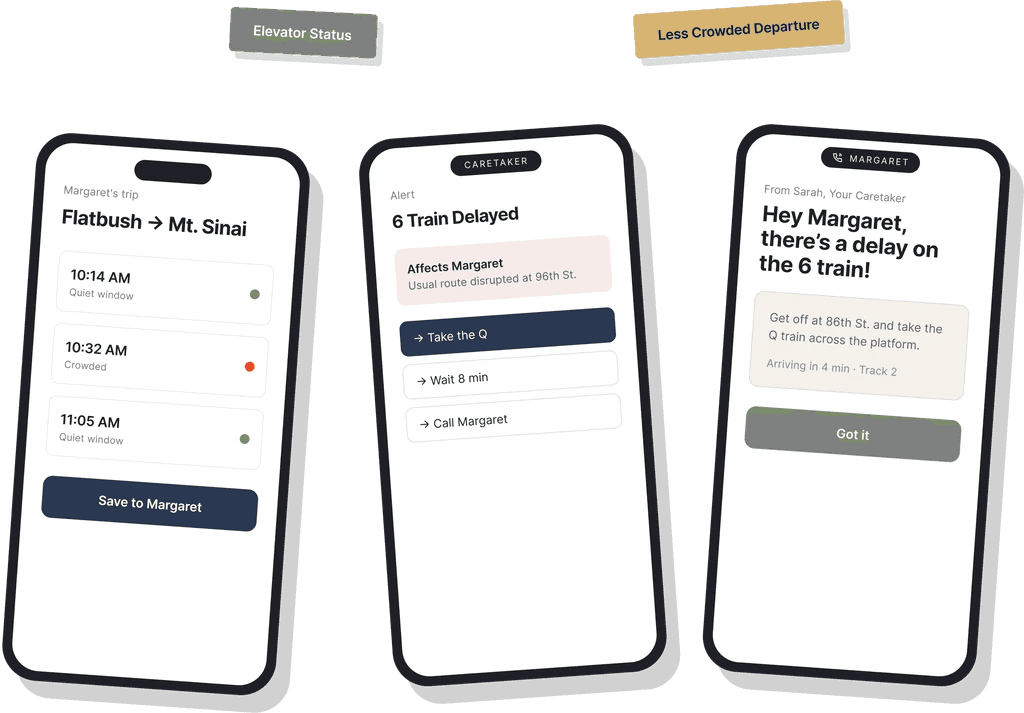
A companion transit app built for older riders and the people who help them. It supports planning, saved trips, and disruption alerts without turning care into surveillance.
Plan
Compass surfaces quieter departure windows, elevator status, accessible routes, and estimated crowding before the trip begins.
Log
Recurring journeys like doctor visits, grocery runs, and weekly errands can be saved so repeat trips are easier to prepare for.
Alert
When a disruption affects the route, the caretaker receives an alert and the rider gets one plain-language next step.
3
Not Another Transit App
Compass was not designed to replace the MTA app or become a safety tracker. It was designed to reduce uncertainty for people who already rely on small networks of care.
The Look Out Campaign
A visual and audio-first campaign designed within the language of MTA signage. It uses posters, platform cues, and social media to normalize small acts of care.
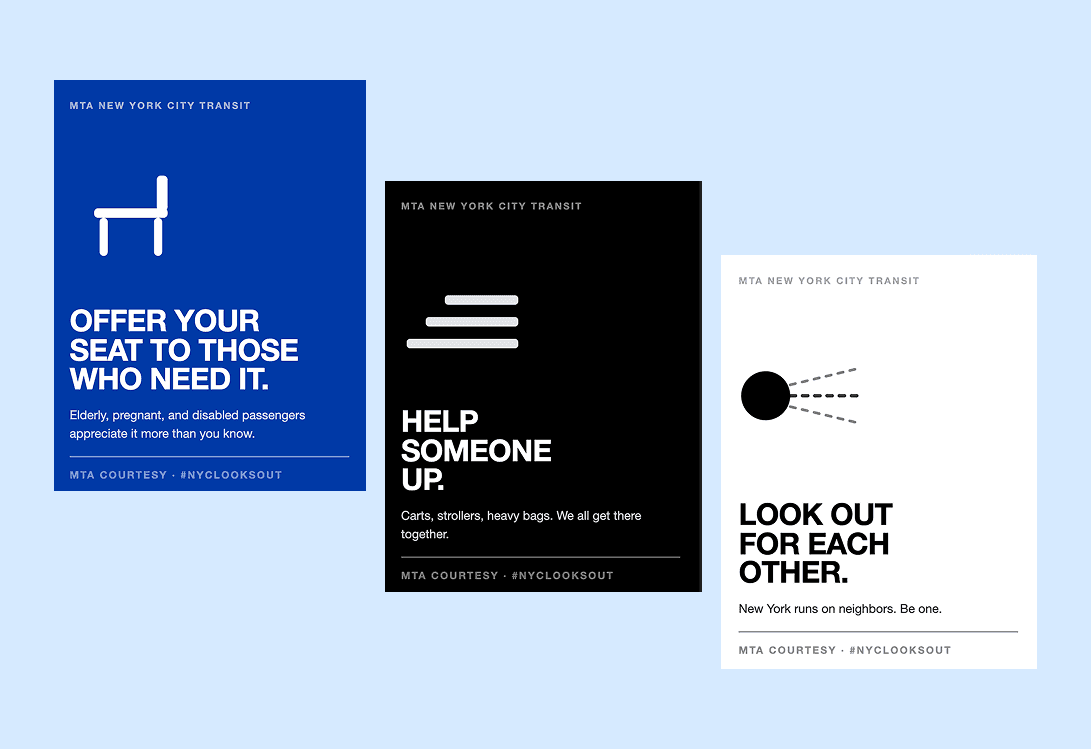
Signal
In-train posters and platform signs remind riders to offer seats, walk slowly, make space, and look out for each other.
Shift
The campaign does not demand courtesy. It makes helpful behavior feel visible, normal, and socially permitted.
Share
Social posts invite riders to share real moments of community care, helping the message move beyond the station.
4
How the Solutions Change the Journey
Before the trip, Compass helps the rider start prepared. When the city changes, the caretaker can send one clear next step. Around the rider, Social Signals encourage commuters to make space and offer help.
Success Metrics
Success would not only be measured by app usage. We would track whether older riders complete more trips, whether caretakers feel less anxious, whether campaign messages gain engagement, and whether commuter behavior changes in pilot stations.
Next Steps
Next, we would prototype Compass with caretaker–older-adult pairs, pilot Social Signals in one Manhattan and one outer-borough station, and expand the persona base to include bus riders, partially sighted riders, and unaccompanied older adults.
Key Learnings
This project taught me that accessibility is not only about infrastructure. For older riders, confidence depends on preparation, social support, and clear recovery moments when the plan changes. The strongest design opportunities came from understanding the space between the map and the lived journey.